

There is a portrait of me that has hung in my mother’s home for decades.
I was five years old when she commissioned it. A local seamstress created a dress specifically for the portrait, and a local artist painted me sitting on a bench on the grounds of Reynolda Gardens in Winston-Salem, North Carolina.
I have photographs from that season of my childhood, too. But there is something different about the portrait.
It was created with permanence in mind.
My mother made a series of deliberate choices—the dress, the setting, the artist, the scale, the frame—because she was not simply documenting what I looked like at five years old. She was commissioning something our family would keep.
And we have.
Decades later, that portrait remains in her home. One day, it will leave her walls and become part of mine or one of my children’s.
That is what makes an heirloom different from something we simply own. An heirloom is created—or eventually chosen—with the expectation that it will outlast us.
It is also the philosophy behind the Painterly Portraits we create at Meghan Goering Photography.
What Makes a Portrait an Heirloom?
We use the word heirloom often, but its meaning is remarkably simple: an heirloom is something of value that is passed from one generation to another.
Its value does not necessarily come from rarity or monetary worth.
It comes from association.
A piece becomes significant because of the person it belonged to, the family it depicts, the story attached to it, or simply because it occupied a familiar place in a home for so many years that it became inseparable from our memory of that home.
Portraiture is particularly suited to becoming an heirloom because the subject of the artwork is already deeply personal.
The portrait does not merely belong to the family.
It is of the family.
The Importance of Creating Something Physical
We have never photographed our lives more extensively than we do now.
That is a wonderful thing. Our phones allow us to preserve ordinary moments that previous generations might never have documented.
But the abundance of photographs has also changed our relationship with them. Thousands of images can live on a phone while only a handful ever become part of the physical environment in which a family lives.
A commissioned portrait is different by design.
It occupies space.
It is framed, hung, illuminated, and encountered repeatedly as part of everyday life. Children grow up seeing it. Visitors recognize it. Eventually, the portrait itself becomes associated with the room and the home in which it hung.
Over time, the artwork acquires another layer of meaning—not simply because of the person depicted, but because of the years the family has lived alongside it.
That physical presence is one of the reasons portraiture has endured for centuries as a way of recording families across generations.
Commissioned Portraits Are Created With Intention
An heirloom portrait does not begin with the assumption that every photograph should become a painting.
Quite the opposite.
The process is selective.
We consider the child’s expression, clothing, pose, lighting, composition, and the eventual placement of the finished piece. We consider whether a portrait will translate beautifully at a substantial scale and whether its styling will still feel appropriate years from now.
The goal is not to remove every indication of the era in which the portrait was created. That would be impossible—and perhaps undesirable.
Instead, we try to avoid the elements that unnecessarily date an image so that attention remains where it belongs: on the person within it.
This is why classic clothing, restrained styling, thoughtful composition, and exceptional craftsmanship matter.
They allow the portrait to age gracefully.
Craftsmanship Matters
If an artwork is intended to remain in a family for generations, the way it is made matters.
Our Painterly Portraits begin with a carefully created photographic portrait. A professional digital artist then works individually on the image, using custom digital brushwork to give the portrait the softness, depth, and character of a traditional painting while preserving the child’s recognizable facial features, expression, pose, and meaningful details.
The finished artwork can be produced on museum-quality giclée canvas. Families may also choose contoured brushwork applied to the finished canvas, adding physical texture and dimension to the surface.
Custom framing completes the piece.
Rather than treating the frame as an accessory chosen after the fact, we consider it part of the artwork itself. Its scale, profile, finish, and relationship to the home all contribute to how the finished portrait is experienced.
These decisions are not made simply because they make the portrait beautiful today.
They are made because we are creating something intended to remain beautiful for decades.
A Portrait Becomes Part of the Home
One of my favorite parts of designing heirloom artwork is determining where it will live.
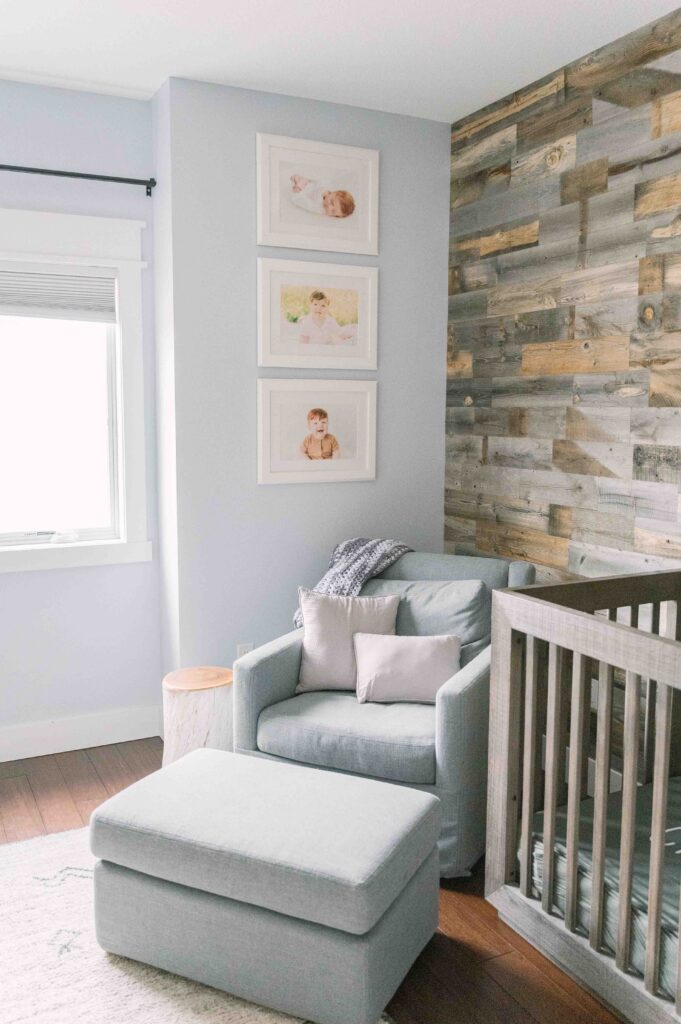
A formal portrait in a substantial gilded frame may become the focal point of a living room or entryway. A quieter portrait might hang in a child’s bedroom. A series of sibling portraits can be designed together so that each child has an individual piece while the collection feels cohesive.
During the design process, we can photograph a client’s wall and use specialized software to display proposed artwork to scale in the actual room.
That allows us to consider the architecture, furniture, proportions, and surrounding finishes before determining the final size and frame.
The result should not feel like a photograph that happened to be hung on an available wall.
It should feel as though the artwork belongs there.
The Meaning of a Portrait Changes With Time
Perhaps the most interesting thing about my childhood portrait is that it means something different to me now than it did when it was painted.
At five years old, it was simply a portrait of me.
As an adult, I see my mother’s choices in it.
I see the dress she had made. I recognize the gardens where she chose to have me painted. I understand the time, expense, and intention required to commission the piece in a way I could not possibly have understood as a child.
And because I now have daughters of my own, I understand something else: she knew that the little girl in front of her would not remain five years old for very long.
The portrait did.
That is the quiet power of an heirloom.
Its subject remains unchanged while our relationship to it continues to evolve.
Creating Something for the Next Generation
When I create an heirloom portrait for another family, I often think beyond the first wall where it will hang.
I think about the possibility that decades from now, one of the children in that portrait will take it into a home of their own.
They may remember the room where it originally hung. They may recognize the frame before they remember anything about the portrait session itself. Their own children may eventually ask who the little girl or boy in the painting is.
That is when the artwork begins its second life.
It is no longer simply something a parent commissioned because a child was three or five or ten.
It has become part of the family’s history.
That is what we hope to create through the Meghan Goering Photography heirloom experience: portraits thoughtfully created, beautifully finished, and worthy of being carried forward.
If you are considering a commissioned portrait for your child or family, explore our heirloom portrait sessions or contact Meghan Goering Photography to begin planning your portrait.

Comments